 Algebra 1
Completing the square
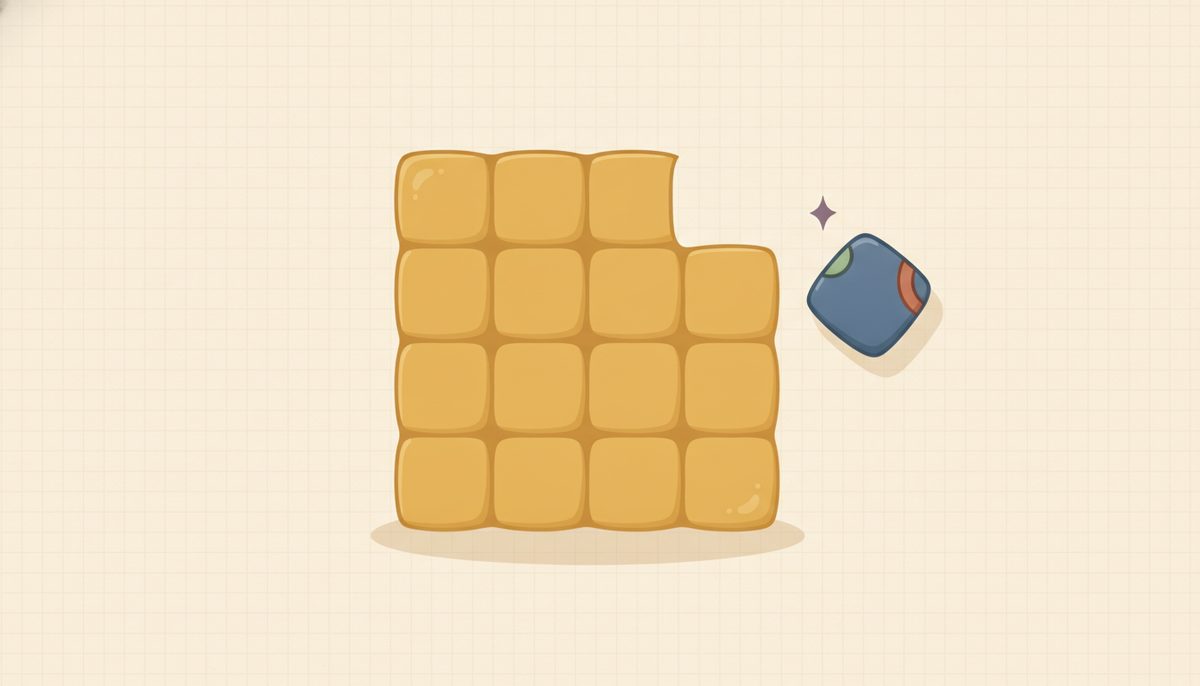
Start with a fact you can check by hand: (x + 3)² = x² + 6x + 9. Look at that constant, the 9. It's exactly (6/2)², half of the middle coefficient, squared. That's not a coincidence, and it's the lever for this whole lesson. If you're handed x² + 6x and want to make it into a perfect square, you now know precisely what to add: 9. Adding the right number to turn x² + bx into something-squared is called completing the square.
There's a literal picture behind the name. Think of x² + 6x as an x-by-x square sitting next to two strips, each 3 by x (the 6x split into two 3x pieces laid along two sides). Those pieces almost form a bigger square, but there's a corner missing: a 3-by-3 block, area 9. Drop that block in and the figure becomes a complete square, (x + 3) on each side. The algebra is doing the same thing the picture is: filling in the missing corner.
Why bother? Two reasons. It solves quadratics that won't factor with nice integers, and it's where the quadratic formula in the next lesson actually comes from. Seeing it once makes that formula feel earned instead of dropped on you.
The move itself, on an equation, is short. Get the x² and x terms alone on one side, add (b/2)² to both sides so the two sides stay equal, factor the left side as a square, and finish with the ±√( ) of Lesson 12.2. Watch the worked examples for how both sides are kept equal on every line.
New words
Worked example
-
12.4.w1 x²+6x+5=0. First move the constant aside and add (6/2)²=9 to both sides to build a perfect square on the left: $$\begin{aligned} &x^2+6x=-5 \\ &\xrightarrow{+\,(6/2)^2=9}\; x^2+6x+9=-5+9 \\ &\Rightarrow\; (x+3)^2=4 \end{aligned}$$ $$\begin{aligned} &x+3=\pm2 \\ &\Rightarrow\; x=-3\pm2 \\ &\Rightarrow\; x=-1 \text{ or } x=-5. \end{aligned}$$ Adding 9 to both sides keeps the equation balanced, the left collapses to (x+3)², and the ± at the root step recovers both solutions. Check: (-1)²+6(-1)+5=0, (-5)²+6(-5)+5=0.
-
12.4.w2 x²+4x-5=0. Move: x²+4x=5. Add (4/2)²=4 to both sides: (x+2)²=9 ⇒ x+2=±3 ⇒ x=1 or -5. Half of 4 is 2, squared is 4, and that's the number that completes the square.
-
12.4.w3 x²-2x-3=0. Move: x²-2x=3. Add (-2/2)²=1 to both sides: (x-1)²=4 ⇒ x-1=±2 ⇒ x=3 or -1. Note half of -2 is -1, so the square is (x-1)², minus sign and all.
-
12.4.w4 Where it earns its keep (factoring fails): x²-4x+1=0. Move: x²-4x=-1. Add (-4/2)²=4 to both sides: (x-2)²=3 ⇒ x-2=±√3 ⇒ x=2±√3. No integer factoring could have found this, but completing the square does, and the answer stays exact in radical form.
A clean case to lock the move in before the practice: complete the square on x² + 6x (just the expression, no equation to solve). Half of 6 is 3, and 3² = 9, so you add 9, giving x² + 6x + 9 = (x + 3)². That's the heart of every example above, on its own.
You've worked the move; here are the spots people stumble. The most common is adding (b/2)² to only one side, which quietly changes the equation and breaks the answer; whatever you add on the left you must add on the right, to keep the balance.
The next is forgetting to halve before squaring, adding b² instead of (b/2)²; the tell is that the left side won't fold into a clean square, so the rule is half of b first, then square.
And the unit's usual one returns at the root step: write the ± so x + 3 = ±2 instead of just x + 3 = 2, or you'll lose the second root. (When b is negative, halving carries the sign: half of −2 is −1, so the square is (x − 1)², not (x + 1)².)
Check yourself
- 12.4.c1 To complete the square on x² + 10x, what number do you add, and how did you get it? (You add 25: half of 10 is 5, and 5² = 25. That makes x² + 10x + 25 = (x + 5)².)
- 12.4.c2 Solve x² + 8x + 7 = 0 by completing the square. Show the balanced step on both sides. (Move: x² + 8x = −7. Add (8/2)² = 16 to both sides: x² + 8x + 16 = −7 + 16, so (x + 4)² = 9. Then x + 4 = ±3, giving x = −1 or x = −7.)
- 12.4.c3 Why does completing the square solve x² − 4x + 1 = 0 when factoring can't? (No two integers multiply to 1 and add to −4, so it won't factor over the integers. Completing the square doesn't need integer factors. It builds (x − 2)² = 3 directly, giving the exact roots x = 2 ± √3.)
You can now complete the square on x² + bx by adding (b/2)² to both sides, factor the result, and solve with the ±. You've also seen why this is the method that still works when factoring can't.
Mixed practice feels harder on purpose, and that's what makes it last. Every answer is at the end of the lesson; if one stalls you, flip back to the worked example it's based on.
State the number that completes the square for:
Reveal answerHide to problem 1
(6/2)²=9Reveal answerHide to problem 2
(-10/2)²=25Solve by completing the square: