 Algebra 1
Proportions & cross-multiplication
Say 4 apples cost $3. At that same price, what do 10 apples cost? The two words doing all the work are same price.
The price-per-apple doesn't change just because you bought more, so the comparison "apples to dollars" stays equal even as both numbers grow. Two equal comparisons like that, set side by side, are a proportion. Most of scaling, from recipes to map distances, is exactly this move.
Start with the picture: stack the two comparisons as equal fractions, keeping the same unit on top on both sides.
$$\frac{4 \text{ apples}}{\$3} = \frac{10 \text{ apples}}{\$x}$$
Apples are on top on the left, so apples go on top on the right; dollars sit underneath on both. That lines the two ratios up to be equal, which is what "same price" means.
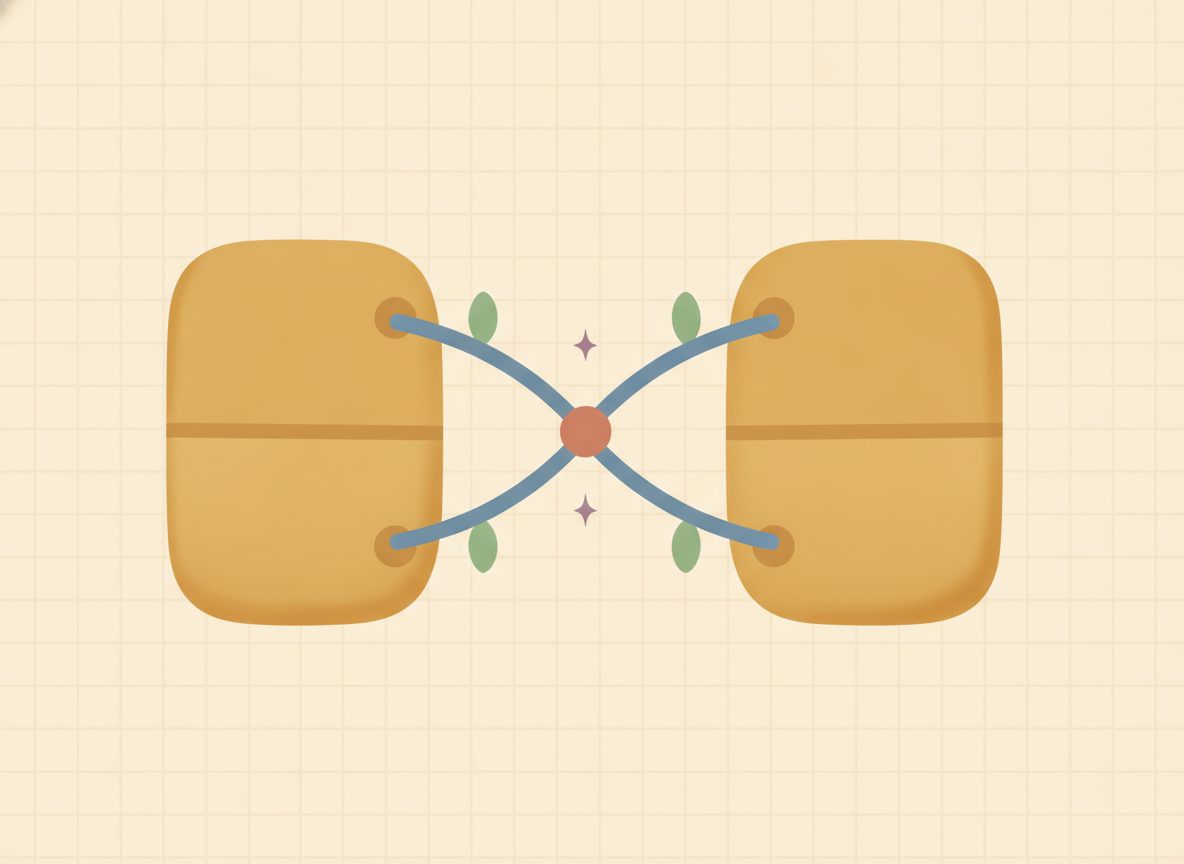
Now for the move that solves a proportion. It has a name, cross-multiplication, and it isn't a magic X. It's the same habit from Unit 2 of doing the same thing to both sides, used twice to clear the fractions. Start from two equal ratios and clear each bottom in turn:
$$\begin{aligned} &\frac{a}{b} = \frac{c}{d} \\ &\xrightarrow{\times b}\; a = \frac{bc}{d} \\ &\xrightarrow{\times d}\; a\cdot d = b\cdot c. \end{aligned}$$
All that happened: you multiplied both sides by b to clear the first bottom, then by d to clear the second. The crossed product a·d = b·c is the result of those two clearings, not a trick you have to take on faith. (This is safe because b and d aren't zero. Multiplying both sides by something that might be zero isn't a reversible move, which is why proportions keep their bottoms nonzero.)
Once the bottoms are gone, what's left is an ordinary one-step equation, solved exactly the way you solved them in Unit 2.
One caution, and it's the deep one for this lesson: cross-multiplication is for direct proportions, where two ratios stay equal. Some real situations move the opposite way. More workers means fewer days, and there the right setup is different.
You'll meet that case head-on in the worked examples and again in problem 7, so the question "is this even direct?" stays alive.
New words
- 3.2.d1 Proportion: a statement that two ratios are equal: a/b = c/d (where b and d are not 0, so the fractions are defined).
- 3.2.d2 Cross-multiplication: for a/b = c/d with b, d ≠ 0, the rule a·d = b·c.
- 3.2.d3 Direct proportion: as one quantity grows, the other grows in the same ratio (more apples → more cost). The ratios stay equal.
- 3.2.d4 Inverse proportion: as one quantity grows, the other shrinks so that their product stays constant (more workers → fewer days; workers × days = total work). The constant product workers × days = k mirrors the constant ratio of the direct case; symbolically xy = k (equivalently y = k/x). (Its graph is a curve, not a line. That's out of scope for now; here we only use the constant-product idea to solve.)
Worked example
-
3.2.w1 Solve a basic proportion. x/4 = 6/8. Cross-multiply to clear the bottoms, which gives 8x = 24; that's a one-step equation, so divide both sides by 8 and x = 3. Check by putting it back: 3/4 = 6/8, and both reduce to 3/4, so it holds.
-
3.2.w2 Variable in a denominator. 3/x = 9/15. First note x can't be 0, since 3/x has to mean something. Cross-multiply: 9x = 45, so divide both sides by 9 and x = 5. Check: 3/5 = 9/15, and 9/15 reduces to 3/5, so it holds.
-
3.2.w3 Word problem (direct). 4 apples cost $3; what do 10 apples cost? Write it with the units inline so the "same unit on top on both sides" rule stays visible, apples over dollars on both sides: $$\begin{aligned} &\frac{4 \text{ apples}}{\$3} = \frac{10 \text{ apples}}{\$x} \\ &\Rightarrow\; 4x = 30 \\ &\Rightarrow\; x = \$7.50. \end{aligned}$$ Cross-multiplying clears the bottoms to give 4x = 30, then dividing by 4 gives x = 7.5. Check: 4/3 = 10/7.5, the same price per apple on both sides.
-
3.2.w4 Inverse, the trap. 5 workers build a wall in 12 days. How long for 3 workers, at the same total work? The thing that's fixed here isn't a ratio, it's the total work: workers × days = 5 × 12 = 60 worker-days. So 3 × t = 60, which gives t = 20 days. Notice it came out bigger: fewer workers means more days. If you'd reached for a direct proportion, 5/3 = 12/t, you'd have gotten the relationship backward, a good reason to ask which way things move before setting up.
Now a clean direct one to get the rhythm back before the practice. If 2 pencils cost $1, what do 6 pencils cost at the same price? Stack the ratios, 2/1 = 6/x, then cross-multiply to 2x = 6, and divide by 2 for x = $3. Check: 2/1 and 6/3 are both 2 pencils per dollar. Straightforward, just the proportion move once.
Two slips show up a lot here. One is doing cross-multiplication without being able to say why. That's the version that gets misapplied, because if it's "just the X trick," nothing stops you from using it on a sum or on an inverse case where it doesn't belong. The cure is to remember it's only "clear both bottoms," so it only fits two equal ratios.
The other is mismatched units: apples over dollars on one side but dollars over apples on the other. Keep the same unit on top on both sides, and the setup stays honest.
Before you set up any proportion, say your plan in a sentence: when this quantity goes up, does the other go up (direct: set the ratios equal) or down (inverse: set the products equal)? Answer that first, then write the setup.
Check yourself
- 3.2.c1 "Re-derive cross-multiplication for a/b = c/d in your own steps. What are you actually doing to both sides?" (Multiply both sides by b to clear the first bottom, leaving a = bc/d; then multiply both sides by d to clear the second, leaving a·d = b·c. It's "do the same to both sides," done twice.)
- 3.2.c2 "A car going 60 mph covers a fixed 120-mile trip; at 40 mph it takes longer. Is trip-time-vs-speed direct or inverse? How would you set it up?" (Inverse: faster means less time, so speed × time is the fixed 120 miles. Set the products equal: 60 × 2 = 120, so at 40 mph, 40 × t = 120 and t = 3 hours.)
- 3.2.c3 "In 2/5 = x/20, without solving, will x be bigger or smaller than 2, and why?" (Bigger. The bottom went from 5 to 20, four times as large, so to keep the ratios equal the top has to grow the same way: x is 4 times 2, which is 8.)
You can now set up a proportion, explain cross-multiplication as clearing both bottoms, solve the leftover equation with your Unit 2 moves, and stop to check whether a situation is direct or inverse before you set it up.
The problems below are shuffled rather than sorted by type. Answers are at the end of the lesson, and a stalled problem is your cue to reread the matching worked example. One of these isn't a direct proportion, so stay alert for it.
Practice
Solve the proportion (direct):
Word problems (set up, then solve):
AnswersTry each one yourself first, then open to check.
- 15x = 30 ⇒ x = 2.
- 40 = 5x ⇒ x = 8.
- 24 = 3x ⇒ x = 8.
- 12x = 72 ⇒ x = 6.
- 7x = 42 ⇒ x = 6.
- 1/50 = 3.5/x ⇒ x = 50 × 3.5 = 175 miles.
- Inverse. Total work = 5 × 12 = 60 worker-days, so 3 × t = 60, giving t = 20 days. (Not 5/3 = 12/t — fewer workers means more time.)
- Unit price $18 ÷ 9 = $2/lb, so 4 × $2 = $8. (Or 9/18 = 4/x ⇒ x = 8.)