 Algebra 1
Percents
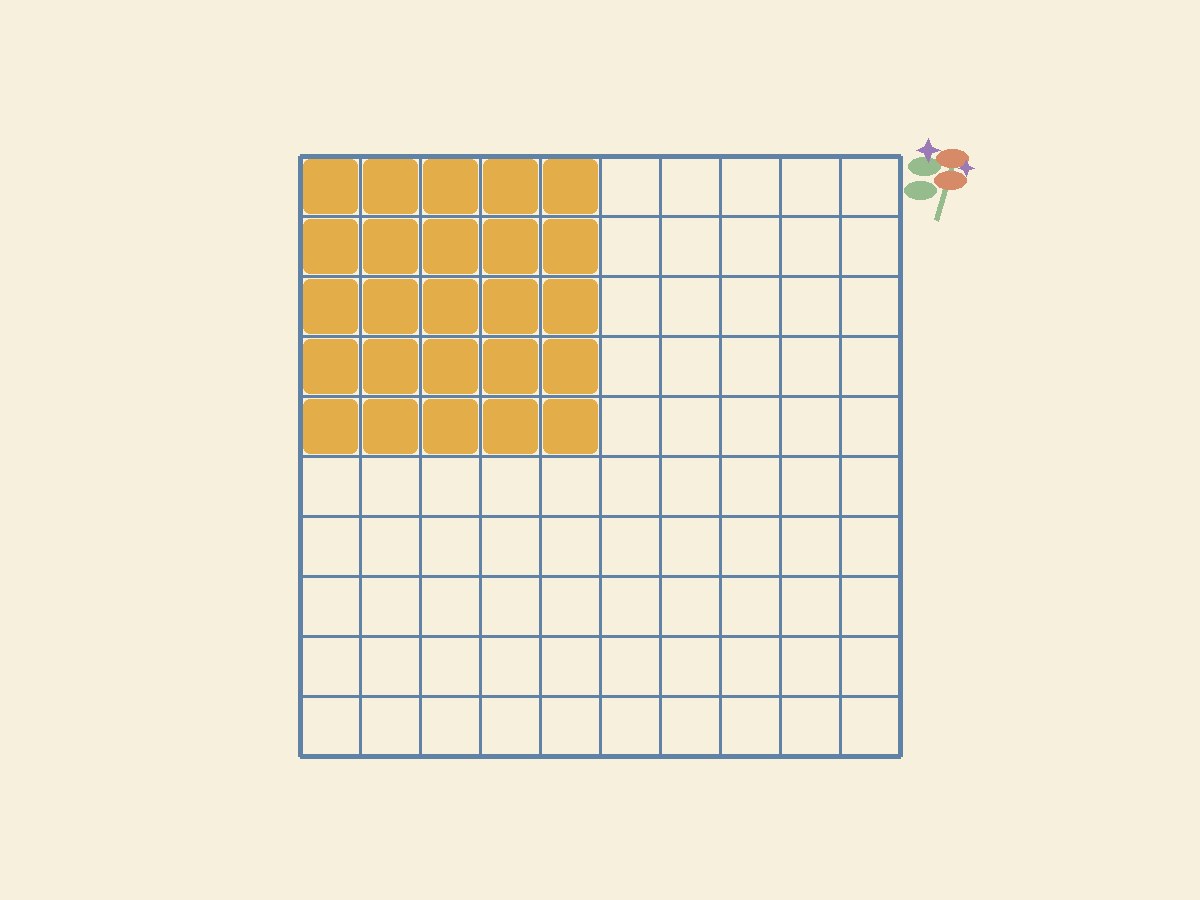
A percent is a count out of 100. Picture a 10-by-10 grid of 100 little squares: 25% is just 25 of them shaded. That's all the word means: "per hundred."
Once you see it as a part out of 100, percents stop being a separate topic and become the proportions you just practiced, with the bottom always set to 100.
It helps to have a few conversions so automatic you don't compute them: 1/2 is 0.5 is 50%, and 1/4 is 0.25 is 25%. Anchor those, and the rest follow by the same logic.
Here's the picture that ties percents to Lesson 3.1. A percent is a part-to-whole comparison, part out of whole, rescaled so the whole is 100:
$$\frac{\text{part}}{\text{whole}} = \frac{\text{percent}}{100}$$
Every percent question hands you two of those three slots and asks for the third, and you solve for it with the same tools as any proportion. Written the other way, that relationship is just part = percent × whole, with the percent as a decimal. The three classic percent questions are only a matter of which slot is missing:
- Find the part: 20% of 80 is 0.20 × 80 = 16.
- Find the percent: 15 is what percent of 60? That's 15/60 = 0.25 = 25%.
- Find the whole: 12 is 30% of what? Then 0.30 × w = 12, so w = 40.
Percent change is the same skeleton with one specific choice of whole: the value you started from. A rise from $40 to $50 is (50 − 40)/40 = 25%, an increase; a drop from $80 to $60 is (80 − 60)/80 = 25%, a decrease.
Keep sliding between fraction, decimal, and percent the whole way through. That fluency is what makes percents quick.
New words
- 3.3.d1 Percent: "per hundred"; a ratio out of 100. 25% = 25/100 = 0.25 = 1/4.
- 3.3.d2 Percent change: how much a quantity grew or shrank relative to its original value: ((new − old)/old) × 100%. It's one signed formula: a positive result is an increase, a negative one a decrease. We report the size with the word that matches the sign. For example, −25% is "a 25% decrease."
Worked example
- 3.3.w1 Find the part. 20% of 80: write 20% as the decimal 0.20, then 0.20 × 80 = 16. Check the size: 20% is about a fifth, and a fifth of 80 is 16, so it fits.
- 3.3.w2 Find the percent. 15 is what % of 60? The missing slot is the percent, so divide part by whole: 15/60 = 1/4 = 0.25 = 25%. Check: 25% of 60 is 0.25 × 60 = 15, back to the start.
- 3.3.w3 Find the whole. 12 is 30% of what? Here part = percent × whole gives 0.30 · w = 12, a one-step equation, so w = 12/0.30 = 40. Check: 30% of 40 is 0.30 × 40 = 12.
- 3.3.w4 Percent increase. $40 → $50: the base is the old value, 40, so (50 − 40)/40 = 10/40 = 25% increase. Check: a 25% rise on 40 is 0.25 × 40 = 10, and 40 + 10 = 50.
- 3.3.w5 Percent decrease. $80 → $60: again the base is the old value, 80, so (80 − 60)/80 = 20/80 = 25% decrease. Check: 25% of 80 is 20, and 80 − 20 = 60.
If a check ever doesn't match, you haven't failed. Your check just caught something before it counted, which is exactly what it's for. Go back to the first line and re-run the arithmetic slowly; a mismatch is almost always one slipped decimal point or one wrong base, not the whole method.
Try an easy one before the practice mixes the three types. What is 50% of 60? Half of 60 is 30. You can do it as 0.50 × 60 = 30, but seeing that 50% just means "half" is the kind of anchor that makes the rest quick.
Three slips catch people on percents.
The first is treating "of" as an automatic "multiply." It works for find the part, where "20% of 80" really is 0.20 × 80, but it misfires on "what percent of" or "is 30% of what," where the missing slot isn't the part. Read the sentence and find which slot is blank before you reach for multiply.
The second is the base in percent change. The denominator is always where you started, the old value, not the new one, and the two aren't interchangeable: $40 up to $50 is a 25% rise, but $50 down to $40 is a 20% drop, because the starting amounts differ.
The third is a decimal-point slip: 7% is 0.07, not 0.7. When you convert, sanity-check against the fraction, since 7% is 7/100.
Check yourself
- 3.3.c1 "Convert 3/8 to a decimal and a percent." (Divide: 3 ÷ 8 = 0.375, and shifting to per-hundred makes that 37.5%.)
- 3.3.c2 "A price rises 25%, then falls 25%. Back to the start? Explain using the base idea." (No. The 25% rise is taken on the original, but the 25% fall is taken on the new, larger amount, so the drop is bigger than the gain. Start at $100: up 25% is $125, then down 25% of 125 is −$31.25, landing at $93.75.)
- 3.3.c3 "$50 → $65 is what percent change, and which value is the base?" (The base is the old value, 50, so (65 − 50)/50 = 15/50 = 0.30 = 30%, an increase.)
You can now move among fractions, decimals, and percents, solve all three percent types by spotting which slot is missing, and find a percent change by measuring against the value you started from.
The thread running through this whole unit is one number: the "per one" amount. It's the unit rate in a price, the constant ratio in a direct proportion, and the per-hundred in a percent. In Unit 4 it becomes the constant in your first clean function, and in Unit 5 it becomes the slope of a line. You'll meet it again there.
These come mixed instead of grouped by type. Answers are at the end of the lesson, and if one stalls you, reread the worked example it matches. The last two take two steps; the rest are one of the three types.
Practice
Find the part:
Find the percent:
- 3.3.3 18 is what percent of 72?
- 3.3.4 9 is what percent of 25?
- 3.3.5 2 is what percent of 3? (The answer doesn't terminate. Decide how to report it.)
Find the whole:
Percent change:
- 3.3.8 A $50 shirt goes up to $65. What is the percent increase?
- 3.3.9 A town's population falls from 200 to 170. What is the percent decrease?
Two-step (real-world, preview of Unit 6):
AnswersTry each one yourself first, then open to check.
(percents reported with their % sign; dollar answers with $)
- 0.25 × 60 = 15.
- 0.40 × 150 = 60.
- 18/72 = 0.25 = 25%.
- 9/25 = 0.36 = 36%.
- 0.70 · w = 21 ⇒ w = 30.
- 0.25 · w = 15 ⇒ w = 60.
- (65-50)/50 = 15/50 = 30% increase.
- (200-170)/200 = 30/200 = 15% decrease.
- Discount 0.15 × 80 = 12, so 80 - 12 = $68 (or 0.85 × 80). Two steps: find the part, then subtract.
- Tip 0.20 × 40 = 8, so 40 + 8 = $48 (or 1.20 × 40). Two steps: find the part, then add.
- 2/3 = 0.6666… = 66.66…%. Report it as 66.7% (rounded to a tenth) or exactly 66⅔% — both are acceptable; just don't write a clipped "66%" without saying you rounded. (A repeating decimal is a real answer; the choice is how precisely to report it.)