 Algebra 1
Variables and the meaning of equations

You already know how to work with numbers. Algebra adds just one new idea: sometimes a number is hidden, and we use a letter to stand for it until we track it down.
Start with the equals sign, because almost everything ahead leans on reading it the right way. The equals sign means the same value: whatever is on the left is worth exactly what's on the right.
Here's a picture for it. Imagine an old balance scale with two pans. If the two pans rest level, the weights on them are equal; that's all "=" claims, that the two sides weigh the same.
So read x + 3 = 7 as that scale resting level: the left pan holds x and 3, the right pan holds 7, and they balance. Here is the one rule to remember: whatever you do to one pan, you do to the other, or it tips.
Reading "=" this way turns a string of symbols into a sentence. On its own, "4 + 3" is just a phrase, the name of a number, the way "the cost of two coffees" names an amount; it doesn't say anything yet. Drop an "=" in and you get a full sentence, with "=" acting as the verb: "4 + 3 = 7" claims the left side and the right side have the same value. A claim like that can be true, false, or, when a piece is still hidden, neither yet. Try reading each of these as a balance and saying which it is:
- 7 = 4 + 3. The right pan is 7, the left pan is 7. They match, so it's true. The single number sits on the left, which can look "backwards" until you remember = just means same as.
- 8 = 8. Nothing to work out, both pans already weigh 8. Still true.
- 5 + 2 = 9. The left pan is 7, the right is 9. They don't match, so it's false.
- □ + 3 = 5 + 7. The right pan is 12, and the left pan won't balance it until the box holds 9. Until you fill the box, it's neither true nor false. It's open.
That box is where algebra begins. Instead of an empty box we usually write a letter, say x, and call it a variable: a closed box with a number hidden inside that we don't know yet.
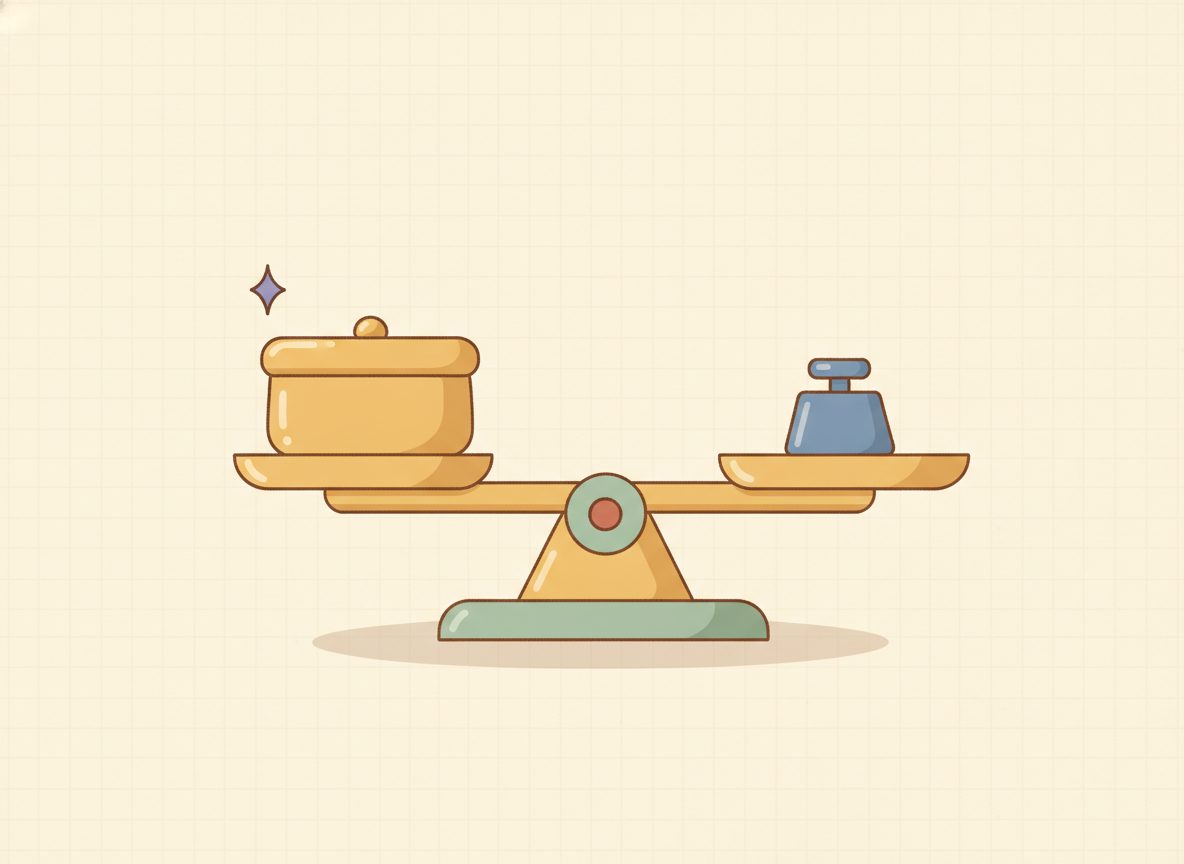
So "3 + x = 7" asks the balance question again: what number in the box keeps the two sides equal?
There's one way to answer it that keeps working no matter how unfriendly the numbers get, and it's the move the rest of the course is built on: undo what was done to x. The 3 is added onto x, so undo it by subtracting 3. To keep the scale level you subtract from both pans, and when you take 3 away from x + 3, the +3 goes to zero, leaving x by itself.
Both pans weigh the same, so the scale is level. Keep it that way.
Goal: get the blue x box alone.
$$\begin{aligned} &x + 3 = 7 \\ &\xrightarrow{\;-3 \text{ from both sides}\;}\; x = 4 \end{aligned}$$
With small numbers you could also just ask the question out loud, "what plus 3 is 7?", and land on four. That's a fine quick check, and here it agrees. But undoing is the method to lean on, because it still works when the numbers don't let you guess.
Now do the one move worth building into a habit today: check it. Put your answer back into the original and see if both sides match. Here x = 4, so the left side is 4 + 3 = 7, which matches the right. So x = 4 is correct.
If a check ever doesn't match, you haven't failed. Your check just did its job and caught something before it counted. That's exactly what it's for. Go back to your first step and re-run the arithmetic slowly; a mismatch is almost always one sign or one small slip, not the whole method.
Notice one small thing in passing. The rule "+3" took an input and turned it into an output: feed in 4, out comes 7. An equation pins down the output and asks you for the input. That input-to-output idea gets its own name later in the course; for now just notice it's there.
New words
- 1.1.d1 Variable: a letter that stands in for a number we don't know yet (not a label for an object). Every copy of the same letter in one problem holds the same hidden number.
- 1.1.d2 Equation: a sentence claiming two things have the same value, joined by =.
- 1.1.d3 Open sentence: a number sentence with a blank or variable; neither true nor false until the unknown is filled (e.g. x + 3 = 7).
Read each worked example slowly, a line at a time, and ask why each line follows from the one above before you go on. That's what makes a worked example teach.
Worked example
- 1.1.w1 Fill the blank so it stays true: 8 + 4 = □ + 5. The left pan is 12, so the right pan has to reach 12 too; that means □ + 5 = 12, so the box holds 7.
- 1.1.w2 True, false, or open? 7 = 4 + 3. Both pans weigh 7, so it's true. The lone 7 on the left doesn't make it backwards; = just means the two sides match.
- 1.1.w3 Solve by undoing: x + 3 = 7. The 3 is added on, so subtract 3 from both sides; the +3 goes to zero and x = 4. Check: 4 + 3 = 7, which matches.
- 1.1.w4 Solve by undoing: 2x = 10. Here x is multiplied by 2, so undo with the opposite, division: divide both sides by 2 and x = 5. Check: 2(5) = 10, which matches.
- 1.1.w5 Solve: x/3 = 4. This time x is divided by 3, so undo by multiplying both sides by 3, giving x = 12. Check: 12/3 = 4, which matches.
Notice that the move only ever does the opposite of what was done to x: undo adding with subtracting, undo multiplying with dividing, and always to both sides. That's the same idea each time, even though the numbers and operations change. Even so, x/3 = 6 is not automatically "the same as" x + 5 = 12; if undoing a division still feels new, treat it as new and check your answer.
Look back at that first example for a moment. It's natural to compute 8 + 4 and write 12, or 9, in the box; that's the calculator habit, where "=" means the answer goes next. But the box plus 5 has to balance 12, so the box holds 7. If you catch yourself writing the running total in the blank, that's the habit talking, and the fix is to come back to the scale and ask what makes the two pans weigh the same.
Try a clean one before the practice mixes things up: solve x − 6 = 0. The 6 is subtracted, so add 6 to both sides; x = 6. Check: 6 − 6 = 0, which matches. Nothing tricky, just the undo move, once.
One more reading habit worth keeping. A letter is some number we don't know yet, not a label for a thing like "apples," so read 5x as "five of whatever the box holds," never as the digits 5 and x stuck side by side. And every copy of x in one problem holds that same hidden number, so if the box turns out to be 6, then 5x is 30, not 56.
Check yourself
- 1.1.c1 Fill the blank so it stays true: 6 + □ = 4 + 5, and put into words how you know. (The right side is 9, so the left side has to reach 9; 6 plus the box must be 9, so the box is 3.)
- 1.1.c2 Is 9 = 9 a real equation? Say why or why not. (Yes. It's a claim that two sides have the same value, and here they plainly do; there's just nothing left to find.)
- 1.1.c3 In x − 2 = 5, which operation do you undo, and why does undoing it tell you x? (The 2 is subtracted from x, so add 2 to both sides; that sends the −2 to zero and leaves x alone, so x = 7.)
You can now read = as a balance, tell a true, false, or open sentence apart, and solve a one-step equation two ways, by inspection and by undoing, and check the answer by putting it back in.
Mixed practice feels harder than repeating one kind of problem, and that's the point. It's what makes a skill last to next week. Every problem below has its answer at the end of the lesson, and if one stalls you, flip back to the worked example it's based on. That's what it's there for.
Judge true / false / open (write which):
Reveal answerHide to problem 1
trueReveal answerHide to problem 2
falseReveal answerHide to problem 3
open (true when the blank is 4)Fill the blank so the sentence stays true:
Reveal answerHide to problem 4
7Reveal answerHide to problem 5
7Solve by inspection or by undoing (show the undo step):