 Algebra 1
Exponential growth & decay; linear vs. exponential
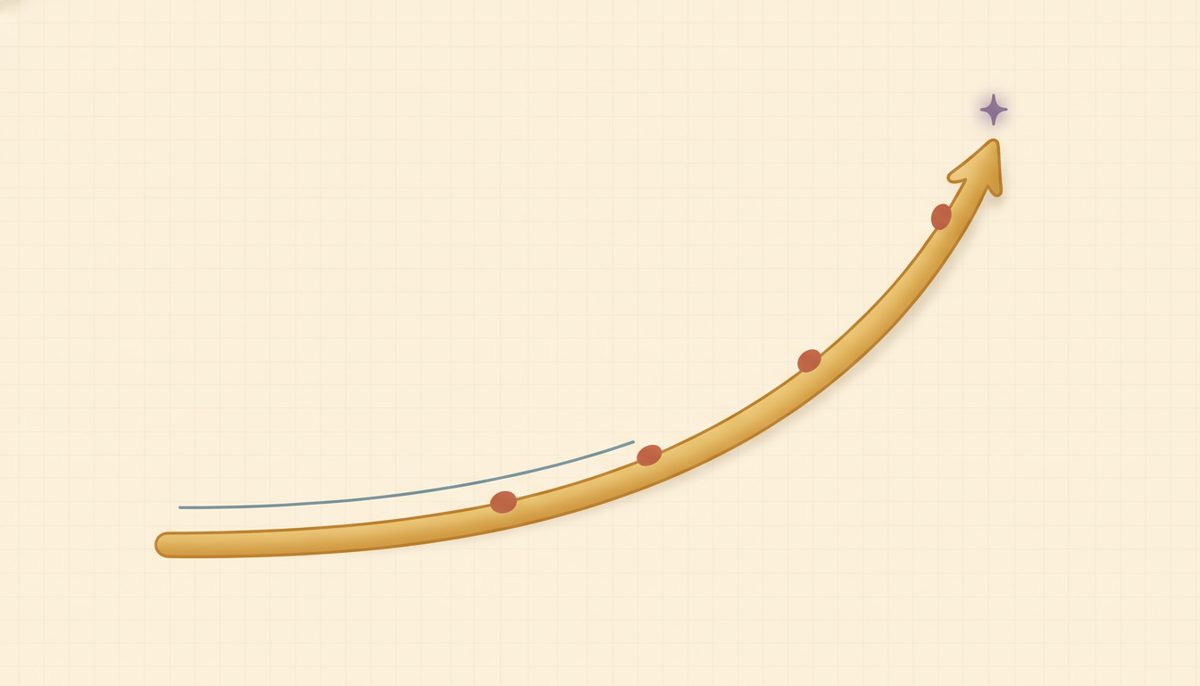
The last lesson's geometric sequence, the kind where you multiply by the same number each step, was a row of separate dots. This lesson fills in the gaps between them and lets the input be any number, not just 1, 2, 3. That smooth version is an exponential function, and it's how you describe money earning interest, a population breeding, or a phone losing value year after year.
Start with the contrast, in money. A linear pattern is repeated adding: you put $5 under the mattress every week, the same five dollars each time. An exponential pattern is repeated multiplying: your money grows by the same percent each step, so the actual dollar amount you add gets bigger and bigger, because a percent of a larger pile is more dollars.
Two quick stories to hold onto. Five bacteria become 10, then 20, then 40: doubling, so you multiply by 2 each step. And an $80 phone that loses half its value a year goes 80, 40, 20, 10, multiplying by 0.5 each step. One climbs, one falls, but both multiply.
Before the function itself, here's the one move that most often goes wrong: turning a percent change into a number you multiply by. If something grows 10%, you don't multiply by 0.10. Think about what "+10%" actually means. You keep the whole 100% you already have and add another 10% on top. That's 110% of what you started with, which is ×1.10.
The same logic runs the other way: "−20%" means you lose a fifth and keep the other 80%, so it's ×0.80, not 0.20 and not 1.20. The factor is always "how much of the previous amount you've got afterward." A useful way to see it: +10% is p + 0.10p = 1.10p, the original plus a tenth of it.
An exponential function is written y = a·bˣ. The a is the amount you start with, and the b is what you multiply by each step. The thing that makes it exponential rather than linear is where the x sits: up in the exponent. In a linear function the variable is multiplied; here it's the power, so each step multiplies the whole running total again.
There's a fence around which a and b are allowed, and each part of the fence earns its place. The starting amount a can't be 0, because 0·bˣ is just 0 forever: no growth, nothing to model.
The base b has to be greater than 0, because a negative base stops being a real number at some inputs (with b = −4, asking for x = ½ means √(−4), which isn't a real number). And b can't be 1, because 1 to any power is 1, so y would just sit at a and never move. So the well-behaved exponential lives where a ≠ 0, b > 0, and b ≠ 1.
The reason b is worth interpreting and not just plugging in is that it reads off the percent change directly. Since b is the fraction of the previous amount you keep, b = 1.05 means you keep 100% and add 5%, that's +5% per period. b = 1.20 is +20%. b = 0.90 means you keep only 90%, so it's −10% per period. b = 0.5 halves, a −50% drop. The percent change lives in the digits past the 1: above 1 is growth, below 1 is a loss of whatever 1 − b comes to.
And a, the starting amount, is the value before anything has happened: the deposit before interest, the population in year 0, the price when new (you get it by setting x = 0, since b⁰ = 1 makes y = a).
The clearest way to feel the difference between the two families is to set them side by side and watch them row by row.
| x | linear y=2x | exponential y=2^x |
|---|---|---|
| 0 | 0 | 1 |
| 1 | 2 | 2 |
| 2 | 4 | 4 |
| 3 | 6 | 8 |
| 4 | 8 | 16 |
| 5 | 10 | 32 |
| 6 | 12 | 64 |
Read down the columns. The line adds 2 every row, a constant difference. The exponential doubles every row, a constant ratio. They're equal in two places, at x = 1 and again at x = 2 (the rows where both read 2, and both read 4). Between those two points the curve actually dips a hair below the line. At x = 1.5 the line is at 3 but 2^1.5 is about 2.83. You can't see that in a whole-number table, but it's real if you graph it.
Then from x = 3 onward the exponential pulls ahead and never looks back: 8 beats 6, and the gap only widens after that. That's the headline about growth: an increasing exponential (b > 1) eventually overtakes any straight line, no matter how steep the line is 9.2.f1. A decaying exponential (0 < b < 1) does the reverse: it sinks toward 0 and overtakes nothing that's rising.
To classify a table on your own, use the exact tool from the last lesson, now with family names attached. Check whether consecutive outputs share a constant difference (that's linear) or a constant ratio (that's exponential). Same diagnostic, new vocabulary.
New words
- 9.2.d1 Exponential function (well-defined):
f(x) = a·bˣ, where a ≠ 0 is the starting amount and b is the growth/decay factor, a number with b > 0 and b ≠ 1.
Each restriction earns its place: a ≠ 0 (if a = 0 then a·bˣ = 0 for every x, so it collapses to the constant 0, not a growth model); b > 0 (if b ≤ 0 then bˣ isn't a real number for some inputs, e.g. with b = −4 the input x = ½ asks for √(−4), which is not a real number); b ≠ 1 (if b = 1 then bˣ = 1 always, so f(x) = a, the constant a, with nothing growing or decaying).
The variable is in the exponent. That's what makes it exponential, not linear.
- 9.2.d2 Starting amount a: the value when x=0 (since b⁰=1, f(0)=a). Like the y-intercept's role, but now it's a multiplier the growth builds on. Interpret it in context: a is the amount you start with before any growth/decay: the initial population, the price when new, the deposit before interest.
- 9.2.d3 Growth/decay factor b: what you multiply by each step (the continuous-function analogue of the common ratio r, same role, now allowed at every real x). b>1 → growth; 0<b<1 → decay. Interpret it in context: b is "what fraction of the previous amount you have after one period," so it directly reads off the percent change: b = 1.05 means +5% per period (you keep 100% and add 5%), b = 1.20 means +20%, b = 0.90 means −10% (you keep 90%, lose 10%), b = 0.5 means −50% (halves). The "+5%" lives in the digits past the 1; a b below 1 is a loss of (1 − b).
- 9.2.d4 Percent ↔ factor: "+p%" → b = 1 + p/100 (e.g. +10% → 1.10); "−p%" → b = 1 - p/100 (e.g. −20% → 0.80). Run it backward too: given b, the per-period change is (b − 1)·100% (positive = growth, negative = decay).
Read these slowly too. Notice the check sitting inside several of them. Substituting back is how you know the value is right, not a chore added at the end.
Worked example
-
9.2.w1 Growth, +10% per year. $100 invested at +10%/yr → a=100, b=1.10, so y = 100·1.1ˣ. Value after 3 years: $$y = 100\cdot 1.1^{3} = 100\cdot 1.331 = 133.10$$ So $133.10. (Note b=1.10, not 0.10: you keep your 100% and add 10%.) Interpret: a=100 is the deposit before any interest; b=1.10 says the balance is 110% of the year before, i.e. +10% each year. Rounding discipline: here 1.1³ = 1.331 exactly, so the value is exactly $133.10. It happens to land on a whole cent. In general, carry the exact value through and round money to the nearest cent only at the very end (this is the "decimal drift" rule below, at its natural home).
-
9.2.w2 Doubling population. 5, 10, 20, 40, ...: multiply by 2 each year → a=5, b=2, y = 5·2ˣ. Check: x=3 ⇒ 5·2³ = 40. This is the geometric sequence of 9.1 (a₁=5, r=2) as its continuous function: the sequence is just the dots at x = 1, 2, 3, …, and y = 5·2ˣ is the curve filling in every x between them (here r becomes the base b).
-
9.2.w3 Decay, halving. An $80 value halved each year → a=80, b=0.5, y = 80·0.5ˣ: 80, 40, 20, 10, ... Since 0<0.5<1, it's decay. Value after 3 years: 80·0.5³ = 80·0.125 = 10.
-
9.2.w4 Percent → factor drill. "+5%" → b=1.05; "−20%" → b=0.80; "doubles" → b=2; "halves" → b=0.5. E.g. a town of 1000 growing 5%/yr after 2 yr: 1000·1.05² = 1102.50.
-
9.2.w5 Classify a table. 3, 6, 12, 24: differences 3,6,12 (not constant) but ratios 2,2,2 (constant) → exponential, b=2. Versus 3, 6, 9, 12: differences 3,3,3 constant → linear, slope 3.
-
9.2.w6 Interpret in context (read what a and b mean). A town's population is y = 1500·1.05ˣ, with x in years. Don't just compute. Say what the model claims: a=1500 is the starting population (year 0, before any growth); b=1.05 means each year the population is 105% of the year before, i.e. it grows 5% per year. Value after 2 years: 1500·1.05² = 1653.75 ≈ 1654 people. Contrast a decay model y = 2000·0.9ˣ (a piece of equipment): a=2000 is the value when new, b=0.9 means it keeps 90% of its value each year, i.e. loses 10% per year; after 2 years 2000·0.9² = 1620. The skill: turn b into a sentence, "+5% a year" or "−10% a year", and a into "the amount before anything happens."
If one of your own answers ever fails its check, where you put a number back and the two sides don't agree, that's not failure, it's the check doing its job and catching something before it counted. Go back to your first step and re-run the arithmetic slowly. With these, a mismatch is almost always rounding too early or slipping on the percent-to-factor step, not the whole method.
With the method working, here are the slips to watch for. The most common is the percent-to-factor one from the top of the lesson, resurfacing under pressure: using 0.10 for "+10%" (which forgets the 100% you already have) or −0.20 / 1.20 for "−20%." Anchor it back to keeping: "+10%" means you still have all of it plus a tenth, so ×1.10; "−20%" means you keep 80%, so ×0.80.
The next one is treating 2ˣ as if it were 2x, applying the "add the same each step" reflex to a "multiply the same each step" object. You'd expect this to give 2, 4, 6, 8; the exponential actually gives 2, 4, 8, 16. The cure is the side-by-side table you just read: ask whether the jump is the same or the ×-factor is the same.
A close cousin is mixing up the factor and the percent itself: reading b = 1.05 as "105% growth," or b = 0.9 as "90% decay." The factor is what you keep-plus-add; the change is b − 1. So b = 1.05 is +5% (not 105%), and b = 0.9 is −10% (you keep 90%, you lose ten). Practice both directions, percent to factor and factor back to percent, until they feel like two readings of the same fact.
A couple of smaller ones round it out. When you evaluate a·bˣ, do the exponent first, then multiply by a. It's a·(bˣ), not (a·b)ˣ. And keep the growth-versus-decay direction straight: b above 1 grows, b between 0 and 1 shrinks, so b = 0.5 is decay, never growth. Finally, the well-defined fence is there to stop you from calling things exponential that aren't: y = (−2)ˣ, y = 1ˣ, and y = 0·2ˣ all break a rule (a negative base isn't real at fractional inputs, b = 1 is just the constant a, and a = 0 is just the constant 0).
One last habit, the decimal one, because it's where careful work quietly goes wrong. Don't round in the middle. Round only at the end. In the first worked example, 1.1³ is exactly 1.331, so the balance is exactly $133.10; if you'd rounded 1.1³ to, say, 1.33 partway through, you'd drift off the true value. Carry the exact number through your arithmetic and round money to the nearest cent only at the very last step.
Here's a clean case to settle the method before the practice mixes things up. Evaluate y = 3·2ˣ at x = 2. The exponent first: 2² = 4. Then multiply by the 3: 3·4 = 12. Exponent, then multiply: that order, every time.
Check yourself
- 9.2.c1 "A $200 laptop loses 20% of its value each year. Write the function y = a·bˣ, and find its value after 2 years. What's b, and why isn't it 0.20?"
- 9.2.c2 "Here are two tables. A: 4, 7, 10, 13. B: 4, 8, 16, 32. Which is linear, which is exponential, and what's the giveaway in each?"
- 9.2.c3 "Linear y = 100x starts way ahead of exponential y = 2ˣ at x=1. Will the line stay ahead forever? Explain what eventually happens."
Worked solutions, so a wrong turn shows you where. For the first, losing 20% means keeping 80%, so b = 0.80 (not 0.20, which would be the part lost, not the part kept), the function is y = 200·0.8ˣ, and after 2 years y = 200·0.8² = 200·0.64 = 128.
For the second, table A adds 3 each step (constant difference), so it's linear; table B doubles each step (constant ratio), so it's exponential. The giveaway is difference-versus-ratio.
For the third, no: even though y = 100x starts far ahead, an increasing exponential overtakes any line eventually, so 2ˣ will pass 100x and then pull away for good. The doubling keeps compounding while the line only adds a fixed 100 each step.
As in the last lesson, the set ahead mixes problem types on purpose, which feels harder and is exactly what makes the skill hold; the answers are at the end, and the worked example behind a problem is there when one stalls you. The classify-the-table pair and the percent-and-factor groups sit next to each other so you keep switching between "is it a difference or a ratio?" and "is this growth or decay?"
Evaluate the exponential function:
Reveal answerHide to problem 1
5·2³ = 40Reveal answerHide to problem 2
80·0.5³ = 10Reveal answerHide to problem 3
100·1.1² = 121Reveal answerHide to problem 4
200·0.8² = 128Reveal answerHide to problem 5
3·2⁴ = 48Reveal answerHide to problem 6
100·1.1³ = 133.10Growth or decay? Give the factor b:
Reveal answerHide to problem 7
growth, b = 2Reveal answerHide to problem 8
decay, b = 0.80Reveal answerHide to problem 9
growth, b = 1.05Reveal answerHide to problem 10
decay, b = 0.5Linear or exponential? (classify the table)
Reveal answerHide to problem 11
linear (constant difference +3)Reveal answerHide to problem 12
exponential (constant ratio ×3)Interpret in context (say what a and b mean, then evaluate):
Reveal answerHide to problem 13
start = 1500 people; b=1.05 → +5% per year (growth); after 2 yr 1500·1.05² = 1653.75 ≈ 1654Reveal answerHide to problem 14
value when new = $2000; b=0.9 → −10% per year (decay); after 2 yr 2000·0.9² = 1620 ($1620)Read the factor back as a percent (growth or decay, and how much per period):
Reveal answerHide to problem 15
growth, +20% per period (since b − 1 = 0.20)Reveal answerHide to problem 16
decay, −15% per period (since b − 1 = −0.15).You can now spot the one contrast this unit is built on: add the same each step is linear, multiply by the same each step is exponential. And you can work both sides of it: classify a list or table, write a sequence step by step or in one jump and move between the two, reach any term with a_n = a_1 + (n−1)d or a_n = a_1·r^(n−1), and turn a percent into a factor b and read a factor back as a percent.
Keep the exponential fence in view as you go: y = a·bˣ needs a ≠ 0, b > 0, and b ≠ 1.